!
ReportAProblem.com
Proof you reported it.

Report dangerous problems. Get proof they were notified.

Potholes. Uneven sidewalks. Damaged guardrails. Blocked exits. Dark parking lots. ReportAProblem.com helps you notify the right public agency or private owner and keeps a time-stamped record so nobody can claim they “didn’t know.”

We log the date & time your complaint is sent.

We keep a copy of what was reported & who was notified.

Use your report as documentation if nothing is fixed.

Built for both public agencies and private property owners.

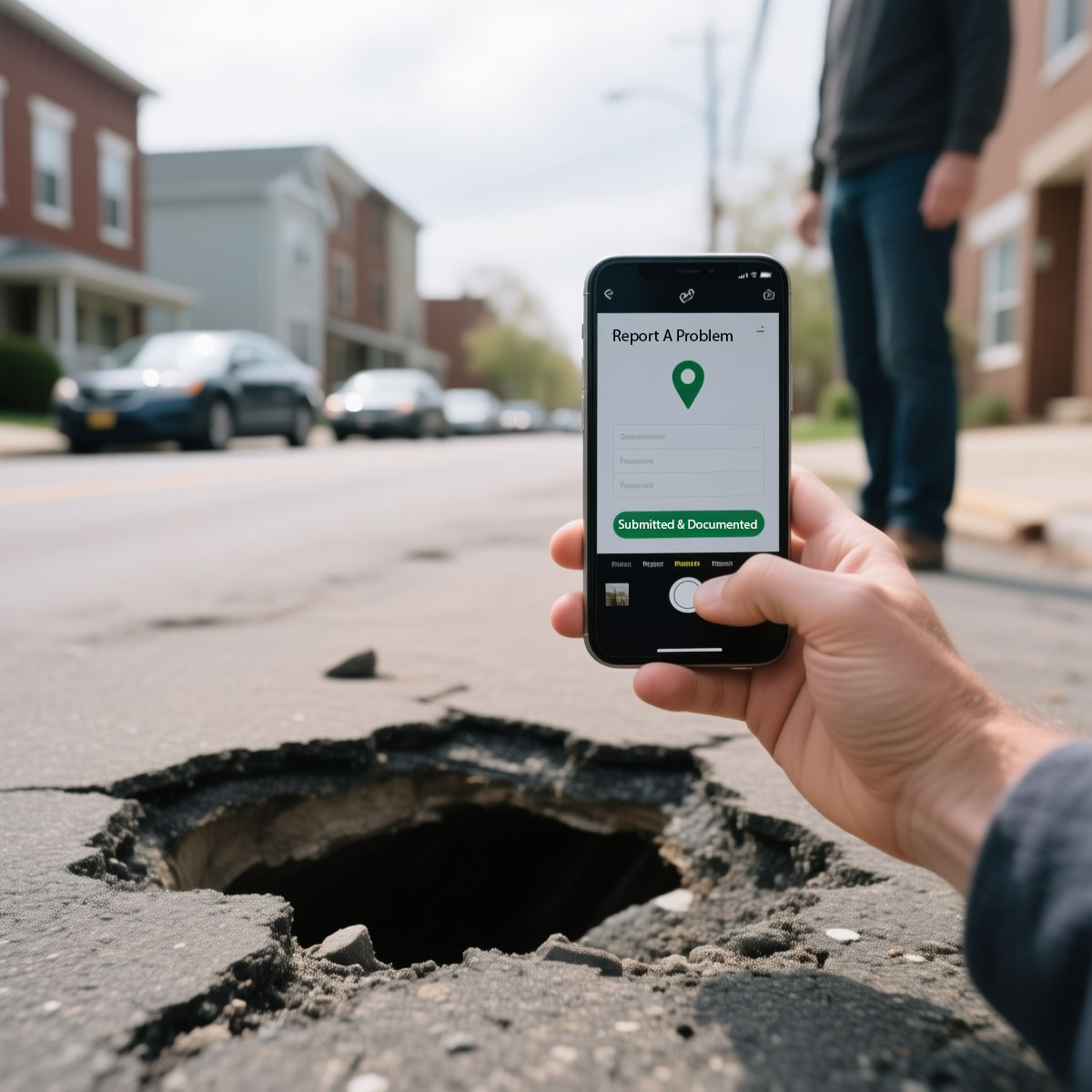
Person photographing a pothole in the street with their phone showing the complaint was submitted for proof of notification

Example proof record

Hazard complaint

Delivered
Location
Main St & 3rd Ave, eastbound lane
Recipient
City Public Works Department
Reported by
Jane Doe <jane@example.com>
Sent on
2025-03-21 14:06 (local time)
Reference ID
RAP-XP4F-9Q2B

Summary

Large pothole in right lane causing cars to swerve into bike lane next to a busy shopping center. Reported to reduce risk of crashes and injuries.

This is an example. Your real reports will show the exact agency or owner, timestamp, and message content.

How ReportAProblem works

We’re not just a complaint form. We’re a documentation tool that protects the public and honest agencies, landlords, schools, and businesses.

1

Describe the problem

Tell us what’s wrong: pothole, uneven sidewalk, damaged guardrail, blocked exit, dark parking lot, broken playground, flooding, or other hazard. Add the exact location and optional photos.

2

We notify the right contact

We route your report to an appropriate department or owner where possible (for example, Public Works, School District, Housing Authority, Property Management, or Business Owner) and send it on your behalf.

3

You get time-stamped proof

You receive a record showing what was reported, who was notified (public or private), and the exact date & time it was sent—so no one can say they “didn’t know.”

What kind of problems can you report?

If it’s a physical hazard or serious maintenance issue that could injure someone, damage property, or block access, ReportAProblem can help you document it — whether the site is public (streets, parks, schools) or private (apartments, workplaces, shopping centers).

Streets & roads

  • • Potholes & sinkholes
  • • Dangerous intersections & crosswalks
  • • Damaged or missing street signs
  • • Broken traffic signals (non-emergency)

Sidewalks & public spaces

  • • Uneven sidewalks & tripping hazards
  • • Broken curbs or ramps
  • • Blocked wheelchair access
  • • Loose or missing utility covers

Buildings & facilities

  • • Blocked or locked emergency exits
  • • Broken handrails or stairs
  • • Chronic leaks, flooding & mold
  • • Unsafe public or common areas

Includes public buildings, schools, apartment complexes, offices, and commercial properties.

Workplaces & commercial sites

  • • Poorly lit parking lots
  • • Slippery floors & loading docks
  • • Dangerous storage or shelving
  • • Hazards in malls or shops

For ongoing safety issues on private property that haven’t been addressed.

Important: For emergencies or life-threatening situations, always contact your local emergency number first. ReportAProblem is for documenting non-emergency issues and proof of notification.

More than potholes: serious problems you can document

ReportAProblem isn’t just for rough roads. It’s for any serious hazard where people have been warning “someone is going to get hurt here” — whether the property is public or private. When those warnings disappear in inboxes or ticket systems, nobody can prove what was said. We help change that.

Schools & playgrounds

Broken or unstable playground equipment, unsecured doors or gates, dangerous pick-up/drop-off patterns, and other hazards around children at public and private schools.

Example: multiple parents warn about a wobbling play structure long before a serious injury.

Buildings & fire safety

Blocked emergency exits, locked or chained doors, storage in stairwells, dead alarms, or obvious electrical hazards in public buildings, apartment complexes, offices, or shops.

Example: residents report a blocked fire exit in a complex months before a fire.

Accessibility & mobility barriers

Missing or broken curb ramps, chronic elevator outages, blocked ramps, or routes that make it impossible for people with mobility devices to access a site.

Example: wheelchair users repeatedly report that an elevator failure makes a station or building unusable.

Flooding, leaks & habitability

Chronic street or yard flooding, roof or pipe leaks, mold, and other conditions that damage homes, businesses, or public facilities over time.

Example: tenants report recurring leaks and mold in publicly funded or privately owned housing.

Trees, poles & public structures

Leaning trees, dead limbs over sidewalks or parking lots, unstable light poles, loose bleachers, or wobbly viewing platforms in parks, campuses, or commercial sites.

Example: neighbors flag a dead tree over a sidewalk that later falls in a storm.

Environmental & health hazards

Strange odors, suspected chemical leaks, illegal dumping, chronic dust or smoke from nearby operations that affect neighborhoods, schools, or workplaces.

Example: repeated reports of strong chemical smells near a drainage channel behind businesses.

Workplaces & commercial property

Repeated employee or customer complaints about unsafe loading docks, poorly lit parking lots, slippery floors, missing handrails, or other hazards at private businesses and offices.

Example: staff and customers report a dark, unsafe parking lot at a shopping center long before a serious incident.

These are examples only. ReportAProblem is meant for non-emergency hazards where advance notice could help prevent someone from getting hurt or suffering major loss.

Built from experience inside public and private organizations.

The idea for ReportAProblem comes from a pattern that shows up in many government agencies and companies: a quiet fear that once something is documented, there may be liability if it isn’t fixed quickly enough.

“If we know about it, and don’t act, then we can be held liable.”

That kind of thinking can turn into a reason not to write things down at all.

When problems stay unofficial, dangerous conditions linger, and the public has no proof they ever tried to warn anyone — whether the issue is on a city street, at a school, in an apartment complex, or at a private workplace.

ReportAProblem.com exists to change the incentives. When you use this site, there’s a clear trail:

  • • A copy of your complaint
  • • Who it was sent to (public or private)
  • • The date and time it was sent

That way, public agencies and private companies can’t claim they didn’t know—and responsible staff have a documented reason to take action. The story behind the idea doesn’t depend on any one meeting or agency; it reflects a broader, well-known tension between risk, liability, and transparency.

For citizens & community members

  • • Simple form, even if you don’t know who to contact.
  • • Time-stamped record of your report for your files.
  • • Optional follow-up reminders so you can check progress.
  • • Works for city streets, schools, housing, workplaces, and more.

For agencies & private owners

  • • Clear, structured reports instead of vague complaints.
  • • Better documentation for risk, maintenance, and liability.
  • • Opportunity to show you respond when the public speaks up.
  • • Insight into patterns of hazards across your streets or properties.

Interested in direct integrations or dashboards for your city, district, or property portfolio? Contact us to talk about partnerships.

Why proof of notice matters

When something goes wrong — at a school, in a public space, in housing, or at a business — one of the first questions people ask is: “Did anyone ever warn them about this?”

When warnings aren’t documented

  • • Complaints get lost in email inboxes, call centers, or ticket systems.
  • • New staff or new leadership may have no idea what was reported before.
  • • People who spoke up are left saying “I know I told someone,” but can’t prove when or how.
  • • Public agencies and private companies can claim they never knew there was a problem.

When notice is clear and time-stamped

  • • There’s a record of what was reported, where, and to whom.
  • • The date and time show how long a public or private owner had to act.
  • • Responsible staff can point to documented reports when asking for budget or repairs.
  • • If there is a dispute later, people aren’t relying only on memory or verbal conversations.

ReportAProblem.com doesn’t decide who is at fault or what should happen next. What it does is create a clear, independent record that a problem was brought to someone’s attention — whether that “someone” is a city department, a school, a landlord, a housing provider, or a private company.

Important note: ReportAProblem.com does not provide legal advice and doesn’t replace speaking with a qualified attorney. If you or someone you know has been seriously injured or suffered a major loss, consider talking with a lawyer in your area about your situation.

What your proof of notification looks like

Every report generates a simple timeline you can reference later.

  1. Step 1

    You submit the problem

    “Deep pothole in right lane causing vehicles to swerve into bike lane. Location pinned on map, photo attached. Near Oakview Apartments and the elementary school.”

  2. Step 2

    We send it to the responsible contact

    The report is formatted and delivered to the appropriate public works / transportation contact or property management, depending on where the hazard is located.

  3. Step 3

    You receive a record

    You get a confirmation with a reference ID, the agency or owner name, and an exact timestamp, so you can prove notice was given if anyone asks later.

Report a problem & create a record

Fill out the form with as much detail as you can. We’ll use this information to route the report to the right public agency or private owner where possible and create a time-stamped record for you.

Note: This form is a demo layout. A backend service is required to actually submit and store reports, send emails, and create persistent proof records.

Photos help agencies and owners understand the severity and exact location.

In a full implementation, clicking this button would generate a reference ID, log a timestamp, send your report to the selected agency or owner, and email you a copy for your records.

Frequently asked questions

Is this an official government website?

No. ReportAProblem.com is not an official government website. It is an independent service designed to document your complaint, route it to the appropriate agency or organization where possible, and give you a proof record of what was reported and when.

Can agencies or owners see the same reports I see?

The goal is for public agencies and private owners to receive a clear, formatted version of your report. Over time, partner organizations may also have access to dashboards and logs to track what’s been reported in their area or portfolio.

What if I don’t know who is responsible?

That’s common. Just describe the location and the problem. When the service is fully implemented, we’ll use your details to route the report to a likely contact (city, county, state, school, landlord, or property owner where possible).

Is this for emergencies?

No. If someone is injured or there is immediate danger, call your local emergency number first. ReportAProblem is for documenting non-emergency issues and creating a clear record of notification.

Why is proof of notification important?

Without proof, it’s easy for organizations to say they never knew there was a problem. With a time-stamped record, it’s clearer that notice was given, which can encourage faster action and accountability for both public and private owners.

Will my name be shared?

Sharing your name is optional. Including your name and contact information usually makes a report look more legitimate and makes it easier for an agency or company to follow up with you if needed.

Some complaints are of a nature that will almost always require contact details (for example, damage to private property or matters that might involve claims or investigations). Others—like a pothole, uneven sidewalk, or similar general hazard—are often fine to submit without your name, depending on local policies.

The exact rules around anonymity and follow-up can vary by location and organization, and can be refined further as the service is implemented.